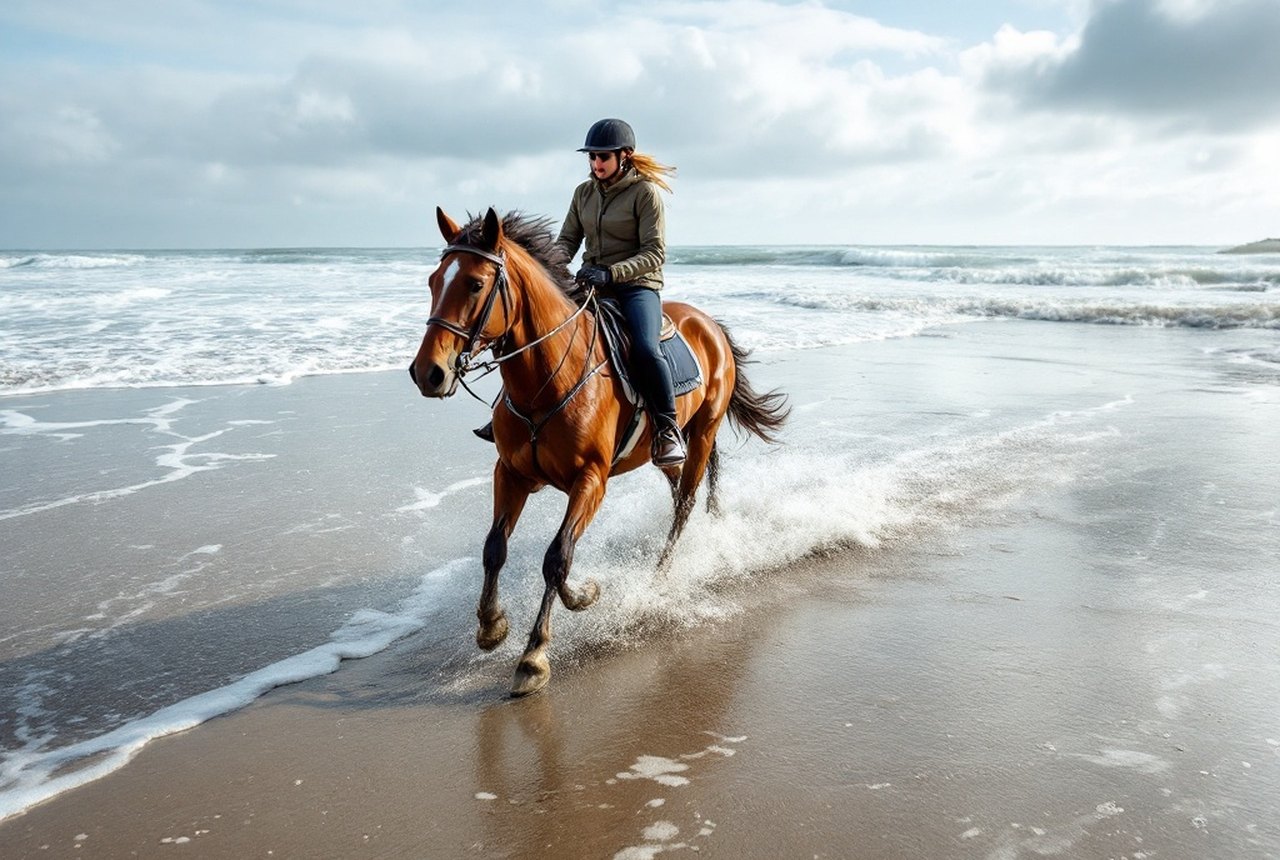
France's longest unbroken stretch of sandy coastline is also one of its most spectacular places to ride — if you know the tides, respect the rules, and choose your season wisely.
01The Silver Coast: A Stage Built for Riders
Stretching roughly 230 kilometres from the Pointe de Grave at the tip of the Médoc peninsula south to Bayonne, the Côte d'Argent is one of Europe's most extraordinary natural corridors. Backed almost continuously by the great pine forests of the Landes de Gascogne, its beaches are wide, flat, and — outside the high-summer crush — gloriously empty. For riders, this landscape offers something rare: the sensation of genuine freedom, a horse lengthening beneath you, salt air in your face, the Atlantic booming to your left.
The beaches around Lacanau-Océan, the Cap Ferret peninsula, Montalivet-les-Bains, and Biscarrosse-Plage are the ones most frequently used by local equestrian centres for coastal outings. Each has its own character. Lacanau offers a broad, exposed ocean beach with a long firm corridor at low tide. Cap Ferret, the narrow finger of sand separating the Bassin d'Arcachon from the open sea, provides an almost surreal ride: tame lagoon to your right, crashing Atlantic surf to your left, and dune grass bending in the wind above you. Montalivet, further north in the Gironde, is flatter and wilder still — popular with naturist holidaymakers in summer but calm and largely private for riders in the shoulder seasons. Biscarrosse-Plage, in the northern Landes, sits between the coastal lakes and the ocean and has long been used by local clubs for early-morning outings when the beach belongs almost entirely to waders and curlews.
02Reading the Tide — and the Sand
The Atlantic at this latitude runs on a pronounced tidal cycle, with a difference between high and low water that can exceed four metres on spring tides. That difference is everything for the coastal rider. At low tide, the retreating sea leaves behind a wide belt of firm, damp sand — compact enough to canter safely on without punishing your horse's legs. As the water recedes further, the sand becomes firmer still, and on a clean ebb you can find a galloping strip that runs for kilometres. Come back two hours later on a rising tide and that same corridor may be knee-deep in surf.
Before any coastal ride, check the horaire des marées — tide tables — for your specific beach rather than the nearest large port, since the Atlantic headlands and estuaries can shift local timings by thirty minutes or more. The Pointe de Grave and the entrance to the Bassin d'Arcachon both influence tidal behaviour along large sections of the coast. Free tide-table apps and the printed tables available from harbour offices and many tourist offices give coefficients alongside times: a coefficient above 80 indicates a strong spring tide with a large tidal range, producing the widest firm-sand window.
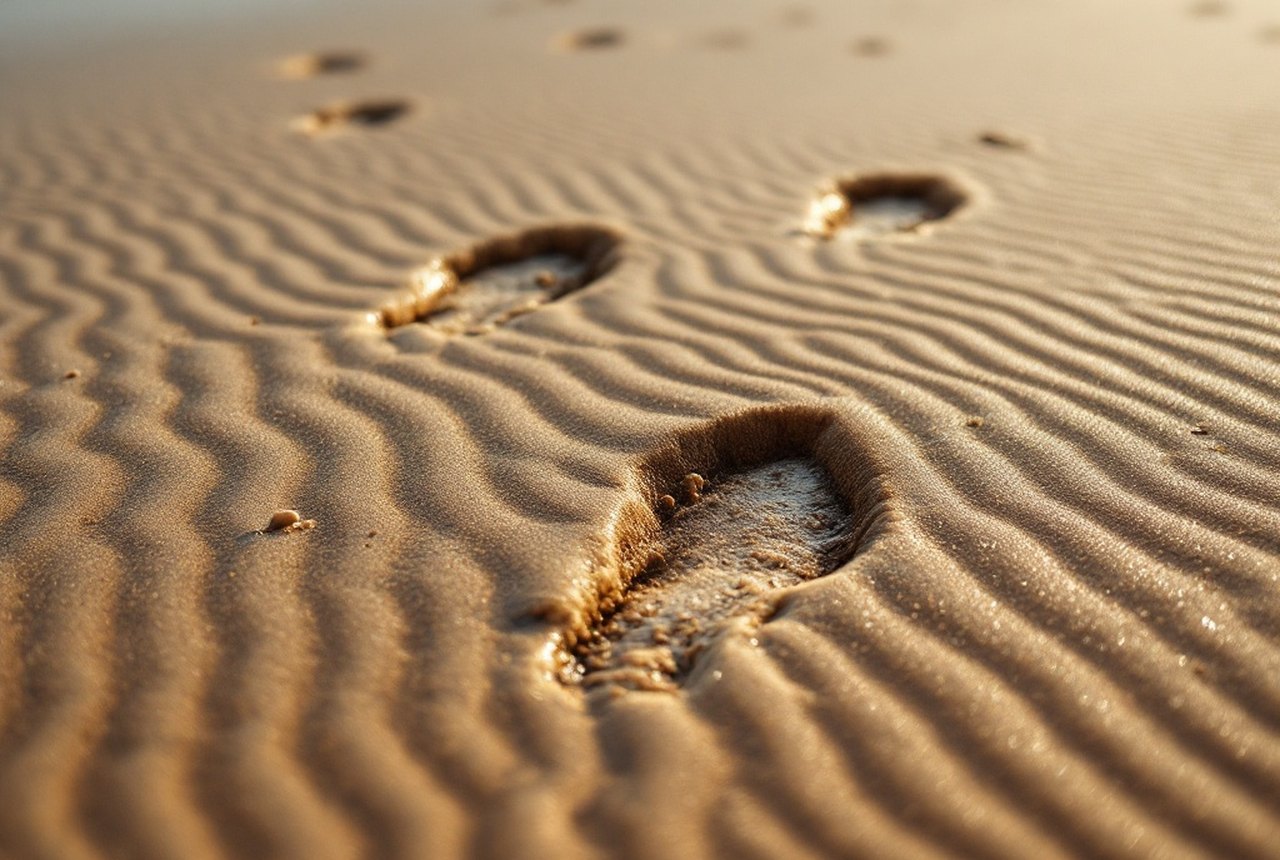
Equally important is learning to read the sand itself. Damp, slightly rippled sand close to the retreating waterline is generally ideal — firm but forgiving. Avoid the dry, loose sand of the upper beach; it drags at the fetlocks and tires a horse quickly, increasing the risk of soft-tissue strain. Watch for darker patches mid-beach that can indicate waterlogged, yielding ground, and always approach any unfamiliar stretch at walk first to test the surface underfoot. The Landes beaches are mostly free of rock, but the surf zone itself can conceal gullies scoured by longshore currents — particularly at Lacanau and Biscarrosse, both of which are serious surfing beaches with powerful wave action.
03Seasonal Access: When Horses Are Welcome
Beach access for horses along the Côte d'Argent is not simply a matter of arrival and tack up. Regulations vary by commune and by season, and they change. As a general principle, horses are prohibited from supervised bathing beaches during the summer season — typically from mid-June through the first or second weekend of September — during the hours when lifeguards are on duty and bather numbers are highest. Outside those hours (early morning before the flags go up, or evening after the beach closes to swimmers) some communes permit access even in July and August, but this must be confirmed locally before you ride. Rules are enforced by beach wardens and by the gendarmerie in some municipalities, and fines can be issued.
In practice, the most rewarding coastal riding happens in spring and autumn. April, May, September, and October offer the full Atlantic spectacle — dramatic skies, long beaches empty of crowds, and light that photographers and riders alike find intoxicating — without the access restrictions of high summer. Winter riding is possible and some local clubs do venture out between storms, but the Atlantic in January is another creature altogether, and only experienced horses accustomed to wind and crashing surf should be taken to the shore in rough conditions.
Check with the local mairie (town hall) or with an affiliated equestrian centre in the area before any outing. Clubs operating in these communes maintain current knowledge of beach bylaws and often have established access tracks through the dune system — knowledge that takes years to build and is invaluable to a visiting rider.
Damp, slightly rippled sand close to the retreating waterline is generally ideal — firm but forgiving.
04Safety in Surf, Sand, and Wind
Even on a calm September morning, the Atlantic edge demands respect. Horses encountering the sea for the first time — or for the first time this season — should be introduced slowly: walk to the waterline, allow them to investigate, and resist the urge to push forward until the animal is relaxed. Salt spray, the unpredictable crash of a breaking wave, swirling foam around the hooves: these are genuine novel stimuli, and a spooking horse on wet sand near surf has very limited purchase for a controlled stop.
Footing in soft sand demands extra care from the rider's perspective too. Work at speed — and a gallop on a firm Atlantic beach is one of équitation's great pleasures — only on the compact tidal strip, keep sessions shorter than you might inland, and be alert to signs of fatigue: a horse working in sand uses significantly more energy than on a standard arena surface. Cool the legs thoroughly after any beach work; saltwater and sand residue can cause irritation and must be rinsed away before you return to the box. Check hooves carefully for compacted sand, particularly if your horse is unshod.
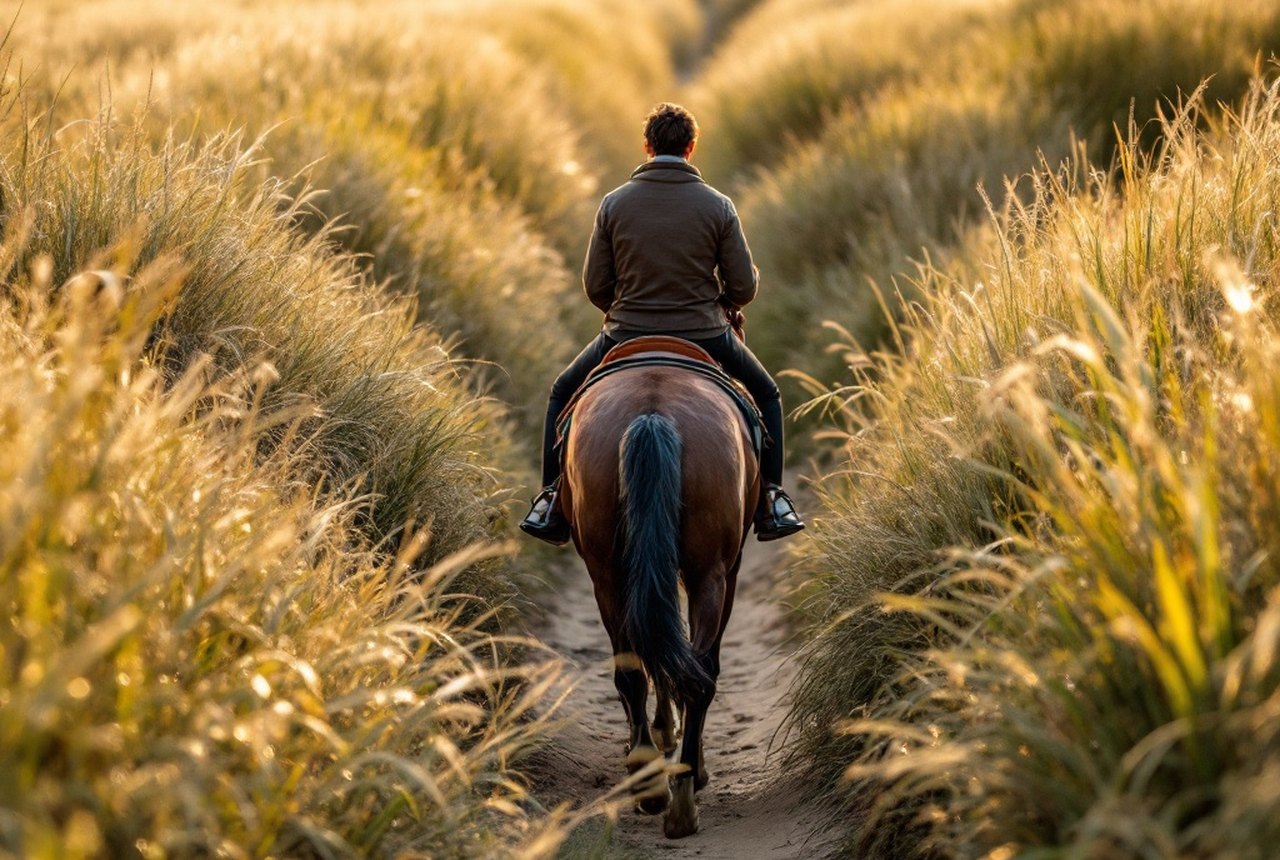
Groups should ride in single file when passing through dune access tracks — these corridors are often narrow, protected under environmental legislation, and shared with walkers and cyclists. The dune systems of the Landes coast are among the most significant coastal dune habitats in western Europe and are treated accordingly by the authorities.
05Making the Most of a Coastal Outing
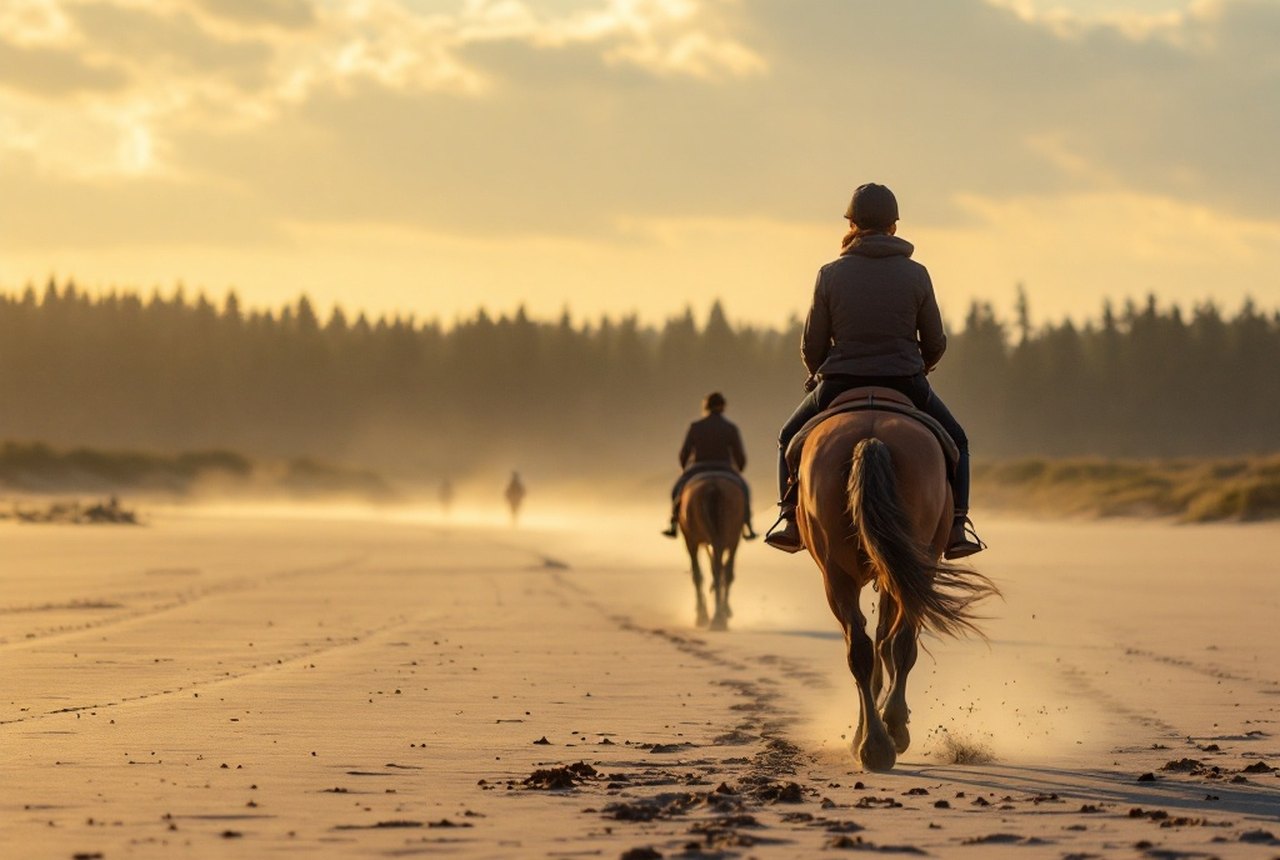
The ideal coastal ride along the Côte d'Argent is unhurried and planned around nature's rhythms rather than the clock. Arrive at the beach two to two-and-a-half hours after high tide: the sand will be firming up nicely, the waterline retreating, and you will have a generous window of good going before the flood returns. Ride north if the prevailing south-westerly is blowing — horse and rider benefit from the wind at their backs on the way out, and a calmer return. Pack a headcollar under the bridle if you plan to let the horse drink from a freshwater source at the dune edge, and carry enough water for yourself on longer outings.
Most importantly, take a moment to simply halt and look out to sea. The Côte d'Argent earns its name not only from the silver light that bounces off the Atlantic on a bright day, but from the quality of stillness that settles over these vast beaches when the crowds have gone. On horseback, at the edge of the ocean, within sight of the great Landes forest — this is equestrian travel at its most elemental, and Nouvelle-Aquitaine offers it with a generosity matched by few coastlines in Europe.