01Why the Landes Suits Endurance and Long-Distance Riders
For endurance riders and those who simply want to cover real ground, the Landes is close to ideal. The terrain is essentially flat — the plateau rarely rises more than a few dozen metres above sea level — which means that horses can maintain a steady working pace without the cardiac and metabolic demands of hill country. The soft, sandy going cushions every stride, reducing concussive stress on limbs and joints. If your horse has been competing hard on hard ground through a summer season, a week in the Landes is both a tonic and a training opportunity: you can build kilometres without accumulating wear.
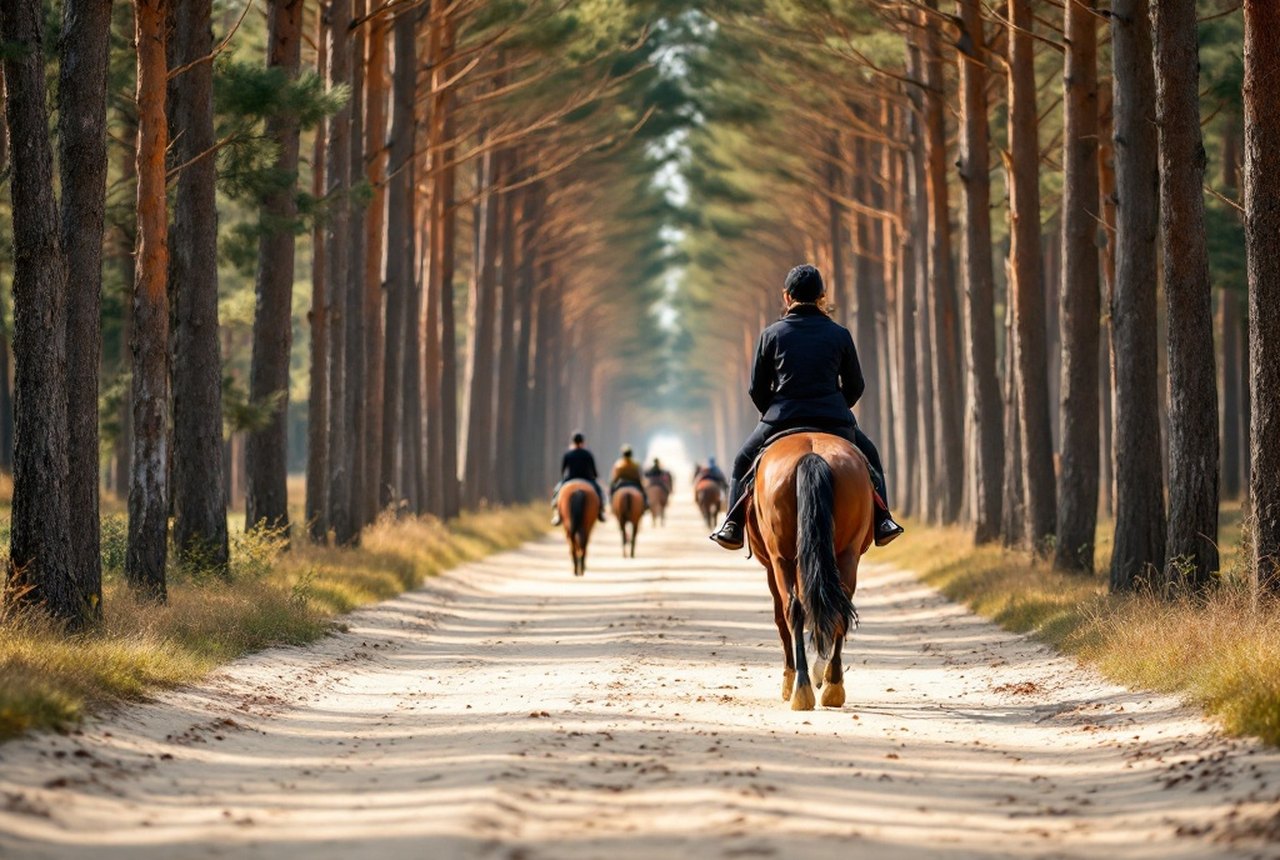
The network of pistes DFCI — that is, the Défense des Forêts Contre les Incendies firebreak tracks — threads the forest in a vast, more-or-less orthogonal grid. These sandy corridors, typically three to five metres wide, exist primarily so that fire-fighting vehicles can access any point quickly. For riders, they function as natural routes: level, clearly defined, largely free of road traffic, and long. One track often runs into the next with no navigable obstacle in between, allowing riders to accumulate serious distances. The region also falls within the broader network of grandes randonnées équestres and local itinéraires de randonnée équestre, signposted trails designed specifically for horse riders, which cross the forest and connect the small Landais towns and villages scattered throughout.
Endurance as a discipline has a real presence in Nouvelle-Aquitaine, governed at national level by the Fédération Française d'Équitation (FFE), and the Landes forest provides the kind of sustained, consistent footing over which base conditioning kilometres can be logged methodically. Even riders not competing in official endurance events will find that a multi-day crossing of the forest rewards a horse with good aerobic fitness and a rider confident in pace management.
02Navigation, Maps, and Getting Oriented
The very quality that makes the Landes so peaceful — its sheer repetitive uniformity — is also the quality most likely to disorient the first-time visitor. Track follows track, pine follows pine, and without careful navigation it is possible to travel a considerable distance in entirely the wrong direction without realising it.
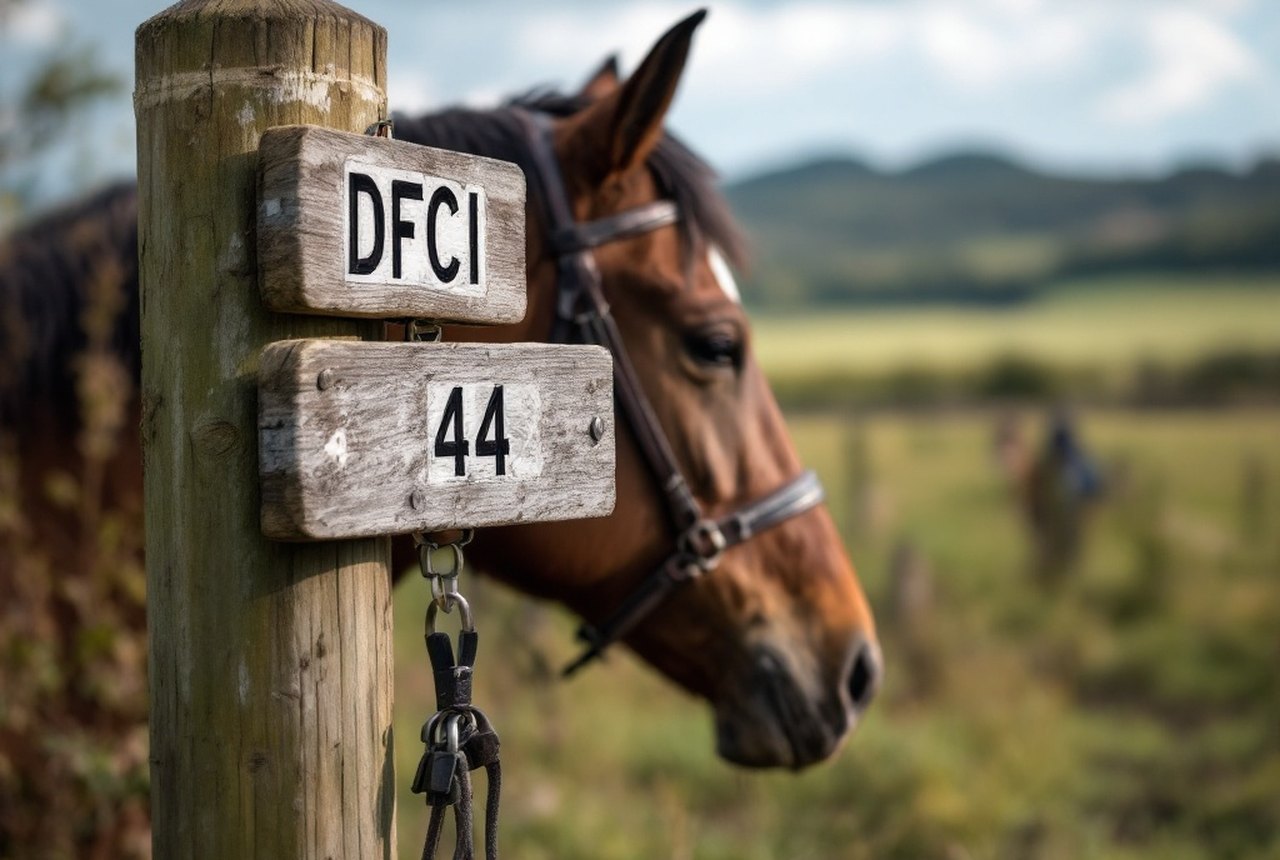
Good preparation is non-negotiable. The IGN (Institut Géographique National) 1:25,000 Top 25 series maps cover the forest in detail, and the pistes DFCI are marked with numbered signposts at most junctions — a system originally designed for fire crews but genuinely useful to riders. Learning to read those junction numbers against a map is time well spent before departure. GPS is helpful as a backup, but batteries and signal are not infallible; carry paper. Local equestrian centres and tourist offices in towns such as Sabres, Pissos, Morcenx, or Mimizan-Bord are good sources of route advice and updated information about any tracks that may be temporarily closed for forestry operations.
The Parc Naturel Régional des Landes de Gascogne — which protects the heart of the forest around the Ecomusée de Marquèze near Sabres — publishes equestrian itinerary information and can advise on waymarked routes suited to different distances and abilities.
03Water, Shade, and Practical Welfare
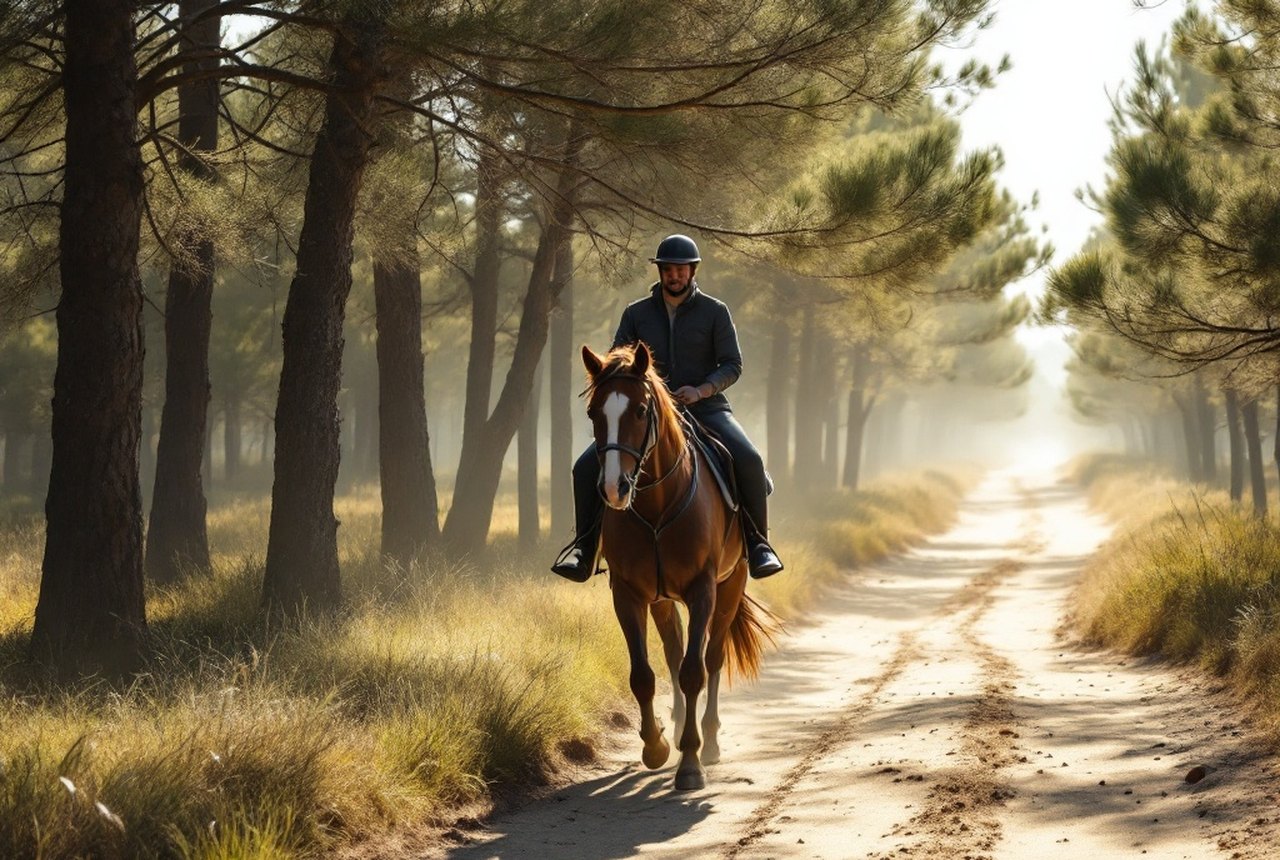
One of the great mercies of the Landes forest is shade: for most of the year, the pine canopy provides genuine relief from direct sun, keeping both horse and rider cooler than open-country routes would allow in the high summer months. Temperatures in July and August can reach well into the thirties, but within the forest they are noticeably lower than on the Côte d'Argent beaches a few kilometres to the west.
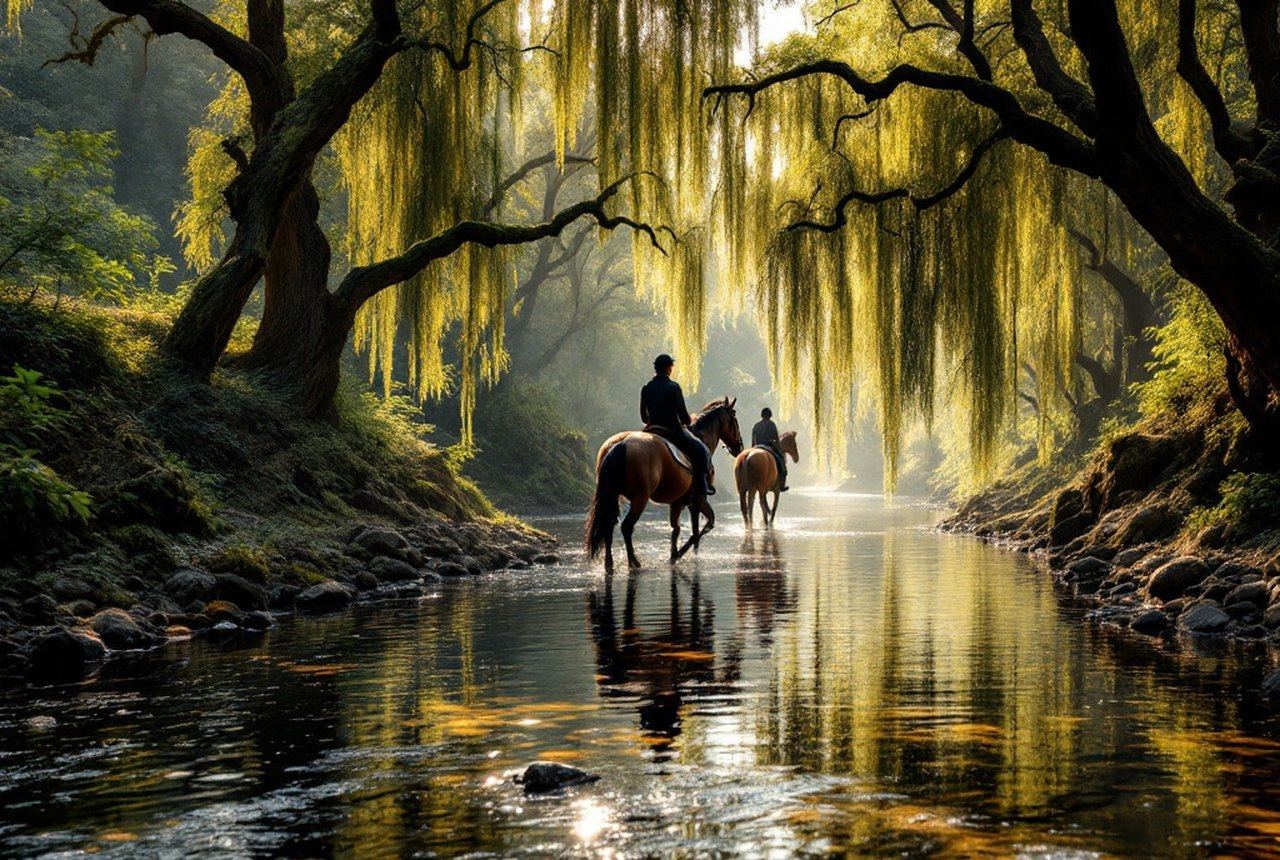
Water, however, requires planning: the forest is crossed by shallow rivers and courants — drainage channels that flow toward the coast — but access points where a horse can actually drink and stand vary. The natural streams of the Leyre river system (the Petite Leyre and Grande Leyre flow through the protected heart of the park) offer reliable watering points, and their banks are among the most beautiful stretches of riding in the region: clear, amber-tinted water moving quietly through gallery woodland. Carry a collapsible bucket; do not rely on finding open water at every stage. On multi-day rides, plotting each day's route around confirmed water sources is as important as planning the distances.
Stable facilities within the forest itself are limited, and multi-day riders typically work from a basecamp, trailering horses to different access points, or plan routes that loop back to a fixed lodge. A small number of equestrian gîtes and farms offering horse-friendly accommodation exist in and around the forest — check with local tourist offices or the FFE's affiliated club network for up-to-date listings.
04The Forest in Every Season
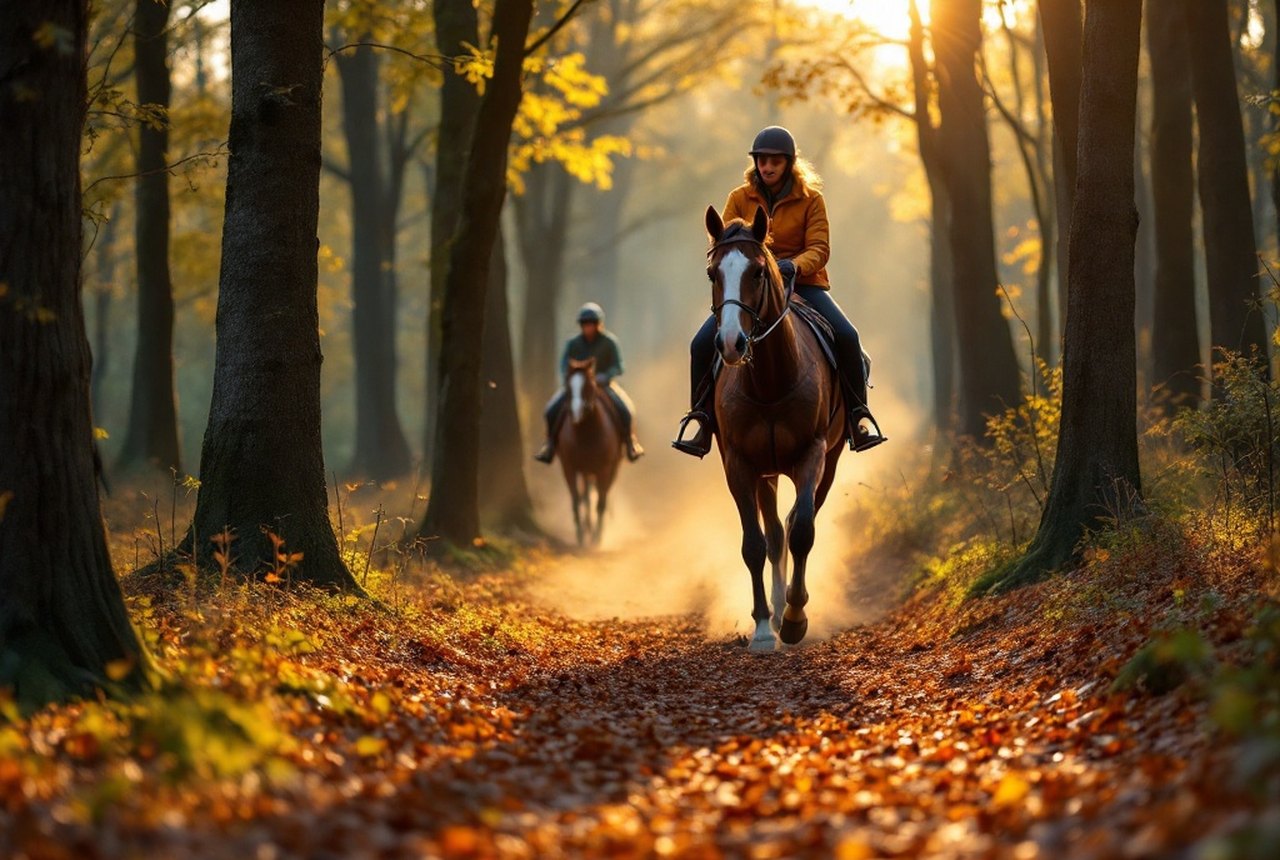
Spring and autumn are the sweetest seasons here. In April and May, the forest floor is bright with the yellow flowers of ajoncs (gorse), and the air carries the resinous warmth of pine in morning sun. In October, the light turns golden and low, and the sandy tracks are firm after summer. Summer riding is perfectly possible — and popular — but forest fire risk is real: be alert to any arrêté préfectoral (prefectural order) restricting access during high-risk periods, which are formally issued by the prefecture of the Landes département when conditions are dry. Such restrictions exist for good reason and must be respected; an errant spark on dry needle-litter can mean disaster for kilometres of forest in minutes.
Winter, by contrast, brings emptiness and a particular austere beauty: pale light, the smell of damp pine, tracks empty of everyone. For the rider who wants silence and solitude in equal measure, a clear January morning in the Landes de Gascogne is difficult to improve upon.
Whatever the season, come prepared to be humbled by scale — and quietly dazzled by it.